
Research Library Analytical Verification
Purity and identity answer different analytical questions. Reliable documentation keeps them separate and interprets each result within the limits of the method used.
For research use only. Not for human or veterinary use.
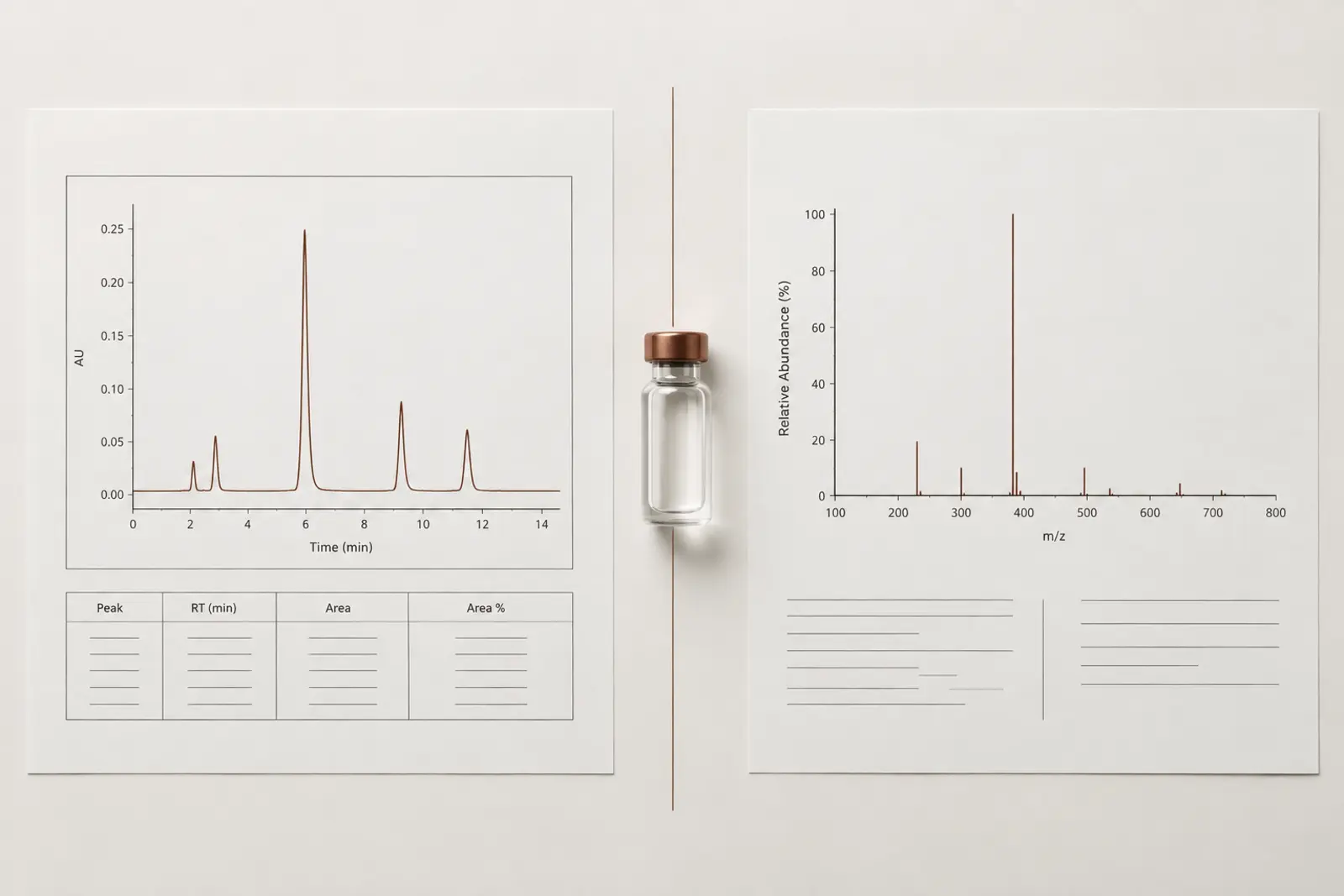
The distinction at a glance
Identity
Asks whether the analytical evidence supports that the material is consistent with the intended compound.
Purity
Asks what the selected procedure measured about the main component relative to detectable impurities or other components.
Neither term is meaningful without the analytical procedure, sample, reference material, and acceptance criteria behind the result.
What identity testing evaluates
An identity procedure should distinguish the analyte of interest using characteristics connected to molecular structure or other sufficiently specific properties. Depending on the compound and purpose, evidence may include mass information, chromatographic behavior, spectral characteristics, comparison with a reference material, or an orthogonal combination of procedures.
Identity evidence is strongest when the procedure is selective enough to distinguish the target from plausible alternatives or closely related compounds.
What purity testing evaluates
Purity testing evaluates the main component and detectable impurities within the scope of the chosen procedure. In an HPLC report, chromatographic purity is often calculated from integrated detector responses. That percentage is tied to the method and to compounds the system can separate and detect under the stated conditions.
Chromatographic purity is not automatically equivalent to peptide content by mass, molecular identity, sterility, endotoxin status, water content, residual solvent levels, or the absence of every possible contaminant.
Why a high purity number is not an identity result
A chromatogram may show one dominant detected peak, but that peak still must be connected to the intended analyte. Conversely, identity evidence can support that a target compound is present without establishing that the material meets a particular purity specification.
This is why analytical programs often use complementary procedures rather than asking one result to answer every quality question.
See HPLC vs. LC-MS in Peptide Analysis for a method-level comparison of chromatographic purity and mass-based identity evidence.
Method context matters
- Selectivity: Can the procedure distinguish the target or measured attribute from interference?
- Reference material: Is the comparison material appropriately characterized for its intended use?
- Accuracy and precision: Does the procedure produce results suitable for the intended measurement?
- Reportable range: Is the result within the range for which procedure performance has been established?
- System suitability: Did the analytical system meet the predefined checks required for the run?
How to read the two results together
- Confirm that identity and purity are reported as separate attributes when separate procedures were used.
- Identify the procedure supporting each result.
- Match both results to the same sample or lot.
- Review the stated specification and the actual measured value.
- Note important attributes that were outside the testing scope.
Bottom line
Identity asks whether the target analyte is supported by the evidence. Purity asks what the selected procedure measured about the main component and detectable impurities. Reliable interpretation requires both the number and its analytical context.