
Research Library Matrix Biology
GHK-Cu is the copper complex of the tripeptide glycyl-L-histidyl-L-lysine. Research has examined fibroblast behavior, extracellular-matrix organization, wound models, signaling, and oxidative stress. The evidence is model-specific and does not support treating collagen as one simple output.
For research use only. Not for human or veterinary use. This page summarizes laboratory research and analytical considerations. It does not provide medical or cosmetic guidance, dosing, administration instructions, or claims of clinical outcome.
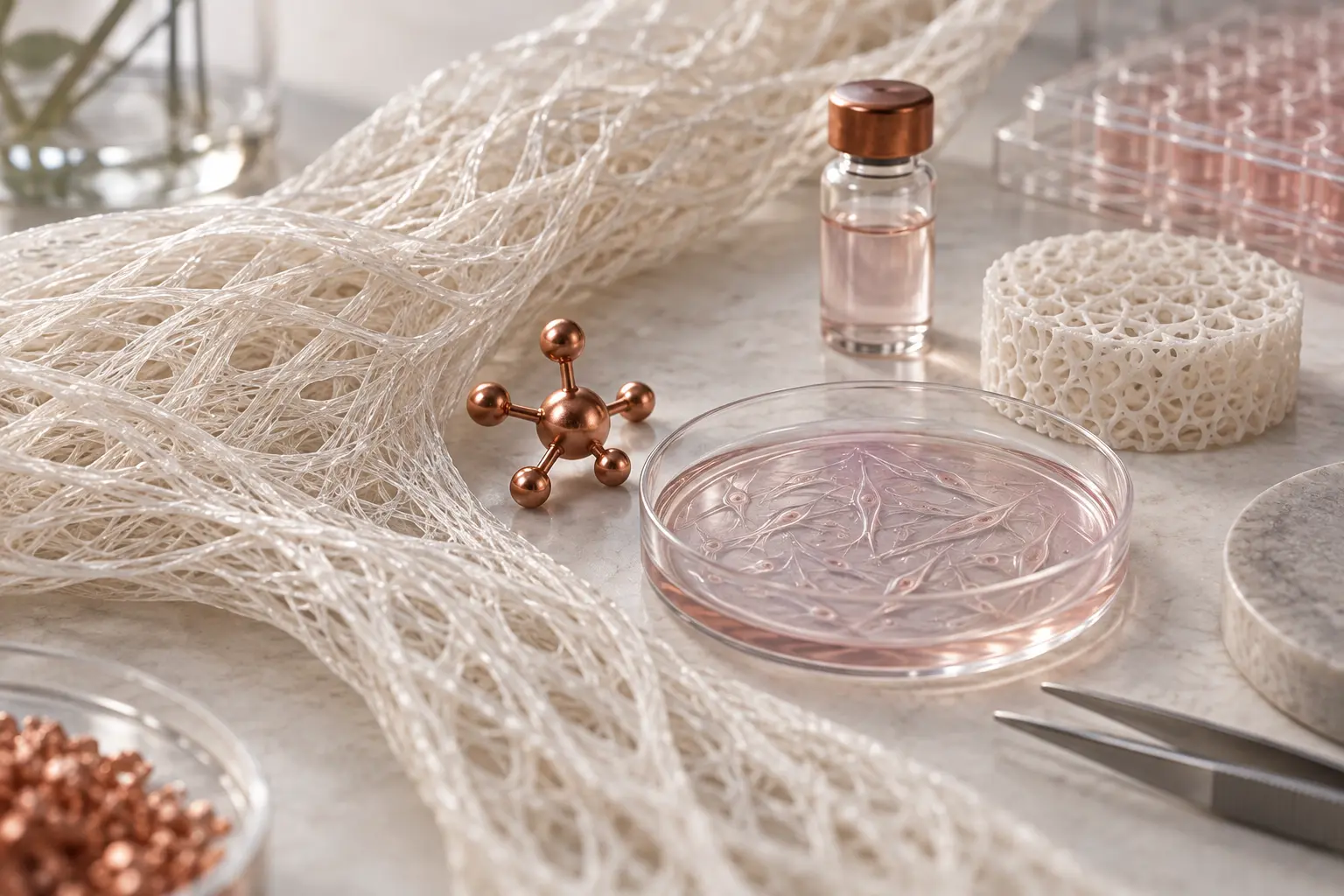
GHK and GHK-Cu are related but distinct
GHK is a three-amino-acid peptide with affinity for copper(II). GHK-Cu refers to the copper-coordinated complex. The free peptide, copper ion, and coordinated complex can differ in stability, redox behavior, transport, and biological response. A study should state which form was used rather than treating the names as interchangeable.
Collagen synthesis is only one part of remodeling
Extracellular-matrix remodeling includes collagen production, degradation, cross-linking, alignment, contraction, and interaction with elastin, glycosaminoglycans, cells, and signaling proteins. More collagen is not automatically better. A useful design asks which collagen type changed, how it was measured, whether organization changed, and whether the result reflects synthesis, reduced breakdown, or altered cell number.
Fibroblast models answer narrow questions
Human dermal fibroblast studies have examined proliferation and growth-factor expression after GHK-Cu exposure. These systems are useful for controlled cellular questions, but results depend on donor source, passage, irradiation history, culture matrix, serum conditions, concentration, and sampling time. A cell-count increase can also change total matrix output without establishing a direct effect on matrix production per cell.
Wound and scaffold models add context
Animal wound models and biomaterial scaffolds add cell migration, vascular response, matrix deposition, and tissue architecture. They also introduce species, injury, material, and delivery variables. Findings from one wound model should not be generalized to uninjured tissue or a different experimental system.
Recommended endpoint groups
- Cell state: viability, proliferation, senescence, migration, and morphology.
- Matrix production: collagen type, elastin, glycosaminoglycans, and total protein.
- Matrix turnover: metalloproteinases, inhibitors, degradation products, and contraction.
- Signaling: growth factors, inflammatory markers, oxidative-stress measures, and pathway activation.
- Structure: fiber organization, scaffold integration, tensile behavior, and histology.
Copper controls are essential
A GHK-Cu experiment should distinguish the coordinated complex from GHK alone and from an appropriate copper control. Copper concentration, buffer composition, pH, chelators, competing ligands, and storage can affect the species present during the assay. Without these controls, an observed response cannot be assigned confidently to the intact complex.
Analytical verification
Identity testing should address the peptide and the intended copper-associated form. Chromatographic purity alone does not establish copper occupancy, concentration, sterility, endotoxin status, or stability in the final assay matrix. Lot records should connect the vial, certificate, and test date, while the experimental record should document solution conditions and elapsed time after preparation.
Evidence boundary
Cellular and animal findings can define mechanisms worth testing. They do not establish broad cosmetic, regenerative, or therapeutic effects. The most defensible interpretation names the model, material form, endpoint, time point, and unresolved variables.
Interpretation checklist
- State whether GHK, copper, or the coordinated GHK-Cu complex was tested.
- Record buffer, pH, concentration, storage, and elapsed preparation time.
- Use matched peptide-only and copper controls where the model allows.
- Separate cell-number effects from matrix production per cell.
- Measure both matrix formation and turnover when claiming remodeling.
- Limit conclusions to the tissue, injury state, species, and endpoint studied.
References
- Pollard JD, et al. Effects of copper tripeptide on the growth and expression of growth factors by normal and irradiated fibroblasts. 2005.
- Maquart FX, et al. In vivo stimulation of connective tissue accumulation by the tripeptide-copper complex glycyl-L-histidyl-L-lysine-Cu2+. Journal of Clinical Investigation. 1993.
- Zhou XM, et al. GHK peptide inhibits bleomycin-induced pulmonary fibrosis in mice. 2017.