
Research Library Analytical Verification
For research use only. Not for human or veterinary use.
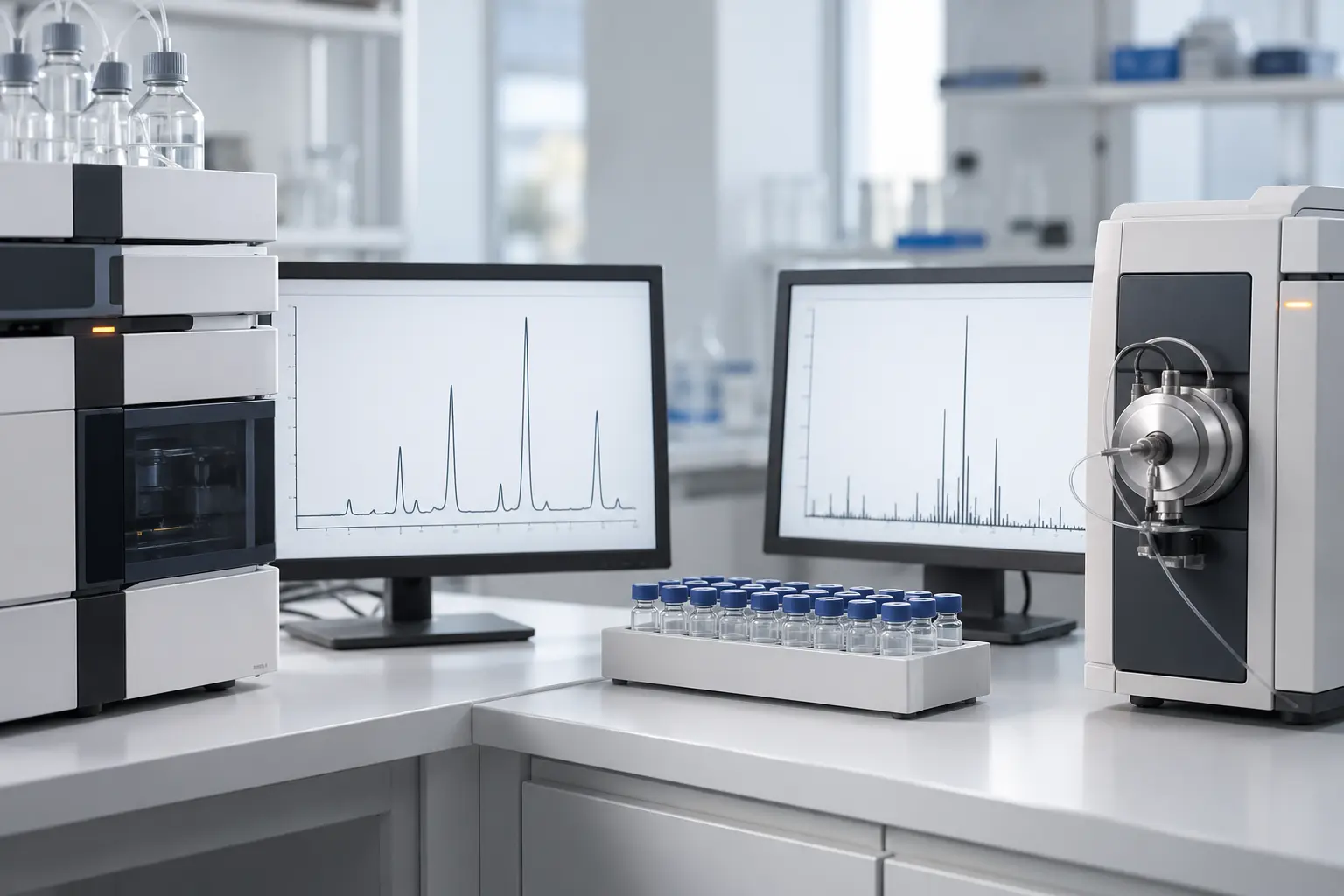
HPLC and LC MS are often presented together on peptide testing records, but they do not provide the same information. Understanding the distinction helps researchers avoid treating a purity result as identity evidence or assuming that one analytical technique answers every quality question.
The short version
High performance liquid chromatography separates components in a sample and can be used to estimate relative purity under a defined method. Liquid chromatography mass spectrometry combines chromatographic separation with mass based detection, adding evidence about the mass to charge characteristics of detected compounds. In practical review, HPLC commonly supports a purity assessment while LC MS can add identity related evidence.
What HPLC evaluates
In an HPLC analysis, the sample moves through a chromatographic system where components separate according to their interactions with the mobile and stationary phases. A detector records the resulting peaks over time. The chromatogram can show the main component and other detectable components under the selected conditions.
A reported area percentage is method dependent. Column chemistry, gradient, mobile phase, detector, integration settings, sample preparation, and run conditions all influence what the method resolves and reports. For that reason, a purity percentage should be interpreted with the named procedure and its suitability in mind.
What LC MS adds
LC MS first separates sample components and then evaluates ions according to mass to charge ratio. When the observed mass information agrees with the expected molecular characteristics, it can support the identity assignment. It may also reveal additional components that benefit from mass based investigation.
Mass agreement is valuable evidence, but it is not a universal guarantee. Interpretation depends on instrument configuration, ionization, charge states, adducts, resolution, calibration, data processing, and the analytical objective.
Why the results are complementary
A chromatographic purity result and a mass based identity result address separate questions. The primary HPLC peak may dominate the chromatogram, but the chromatogram alone does not necessarily prove that the peak represents the intended peptide. Conversely, an observed molecular mass may support identity without describing the complete impurity profile or the relative amount of each detected component.
Questions to ask when reviewing a report
- Is the purity result clearly identified as chromatographic rather than an identity result?
- Does the report name the analytical method and detector?
- Is the expected mass shown alongside the observed result?
- Are charge states, tolerances, or interpretation notes provided when relevant?
- Do the sample identifier and lot number match across the chromatographic and mass based records?
- Are the conclusions limited to the attributes each method actually evaluated?
What neither method establishes alone
HPLC and LC MS do not automatically establish sterility, endotoxin status, residual solvent compliance, water content, fill quantity, or long term stability. Those attributes require their own procedures and controls when they are relevant to a research specification.
Reading the evidence together
The most useful analytical record keeps identity, purity, and other quality attributes separate, then connects them through a consistent sample and batch record. Review Purity vs. Identity in Peptide Testing for the conceptual distinction, or use How to Read a Peptide Certificate of Analysis for a complete document review sequence. The Not Labs release framework is summarized on Testing and Verification.