
Research Library Tissue Signaling
BPC-157 and TB-500 are often discussed together, but they are not interchangeable research materials. They differ in sequence, source framework, and the experimental questions they can support. A useful comparison begins by separating those identities before considering a combined design.
Research-use notice: This overview concerns laboratory and investigational research only. It does not provide medical guidance, dosing information, administration instructions, or claims of clinical outcome. Not for human or veterinary use.
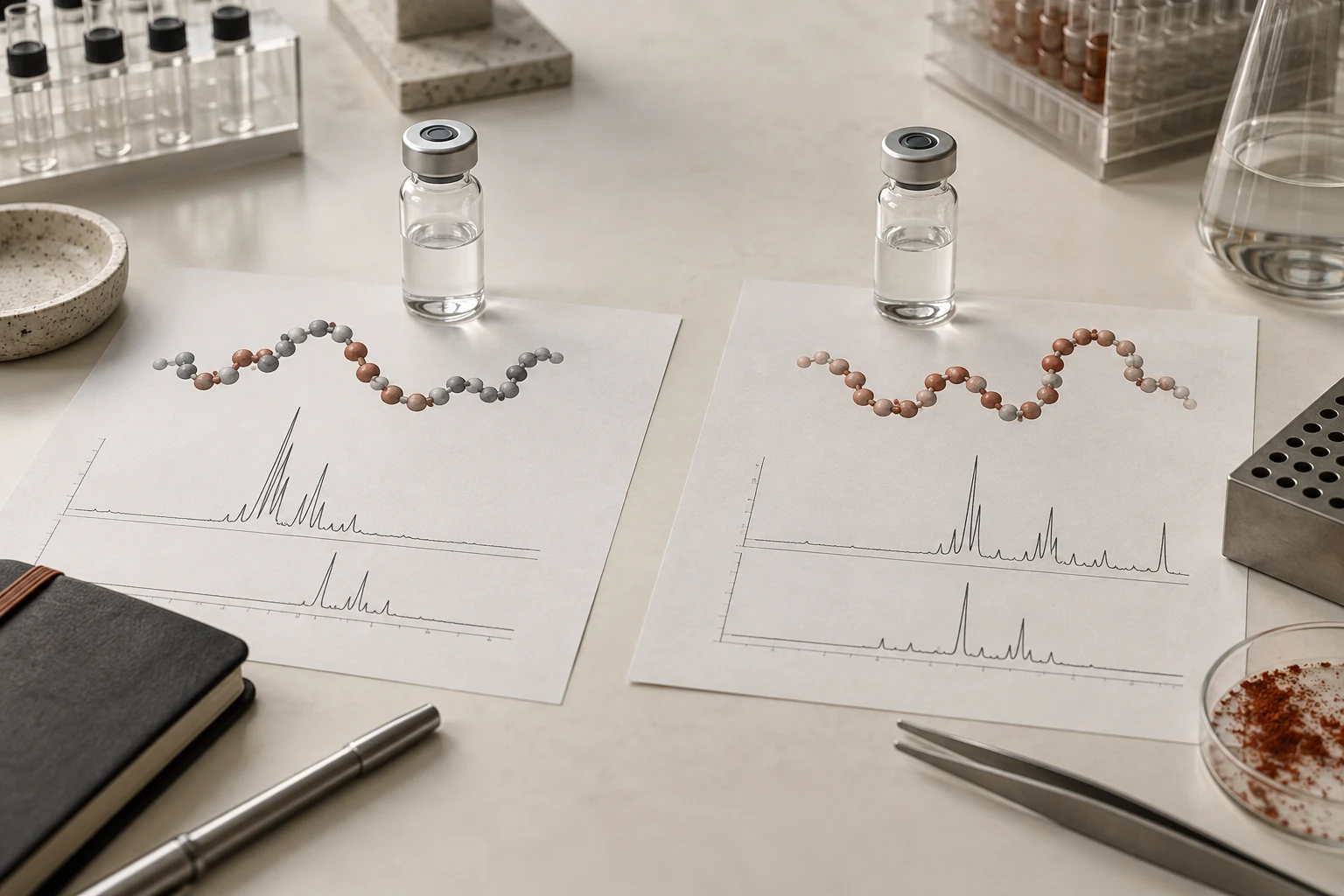
The distinction at a glance
| Research characteristic | BPC-157 | TB-500 |
|---|---|---|
| Material framework | Synthetic 15-amino-acid peptide | Synthetic peptide associated with the thymosin beta-4 research framework |
| Common experimental emphasis | Cell signaling and tissue-associated preclinical models | Actin regulation, cytoskeletal organization, and cell-migration models |
| Primary analytical requirement | Lot-matched identity and purity evidence | Lot-matched identity and purity evidence |
| Comparison limitation | Preclinical findings do not establish human outcomes | Thymosin beta-4 findings should not be assumed to describe every TB-500 material |
The table defines research context rather than efficacy or equivalence. Experimental results depend on the exact material, model, assay, controls, and endpoint. A shared category does not make two peptides mechanistically identical.
BPC-157 as a distinct research material
BPC-157 is a synthetic pentadecapeptide. Published literature is largely preclinical and includes cell-based and animal models. When reviewing a study, identify the model, the reported peptide sequence, the analytical characterization, and the endpoint before applying the paper to a new experiment.
The breadth of reported preclinical topics makes careful interpretation especially important. A result from one tissue model cannot be carried into another without additional evidence. The material record should remain separate from any biological interpretation.
TB-500 and the thymosin beta-4 literature
TB-500 is discussed in relation to thymosin beta-4, an actin-binding peptide examined in cellular-motility and cytoskeletal research. That relationship requires precision. A paper on full-length thymosin beta-4 should not automatically be treated as evidence for a differently specified synthetic research material.
Record the exact analyte named by the publication and compare it with the lot documentation for the material in hand. Sequence, molecular form, method, and study model are not interchangeable details.
Why they appear in the same research conversation
Researchers may place BPC-157 and TB-500 in the same comparative framework because the literature discusses tissue-associated signaling from different starting points. That can support a controlled comparison, but it does not establish complementarity. A combined experiment still needs individual-material controls to distinguish shared observations from compound-specific effects.
- Define the endpoint. State whether the experiment concerns cell migration, cytoskeletal organization, or another measurable variable.
- Verify each material separately. Confirm identity, lot, method, and purity before comparing results.
- Include individual controls. A combined condition alone cannot show which material influenced an observation.
- Match conditions. Keep the model, timing, matrix, and readout consistent across comparison groups.
- Limit the conclusion. Report only what the selected assay and model can establish.
Analytical documentation before comparison
A compound name is not enough to verify a research material. Review the lot identifier, stated analyte, test date, analytical method, identity evidence, purity result, and any method-specific notes. The Certificate of Analysis should connect the tested sample to the supplied batch.
For a premixed material, review the blend-specific documentation. Individual component records do not substitute for evidence tied to the combined batch.
Common interpretation errors
- Treating BPC-157 and TB-500 as equivalent because they appear in the same product category.
- Using full-length thymosin beta-4 literature without checking the identity of the TB-500 material.
- Assuming a purity percentage confirms identity.
- Testing only a combined condition without individual-material controls.
- Extending preclinical findings into claims about human use or outcomes.
References
- Chang CH, et al. The promoting effect of pentadecapeptide BPC 157 on tendon healing involves tendon outgrowth, cell survival, and cell migration. Journal of Applied Physiology. 2011. PubMed record.
- Gwyer D, Wragg NM, Wilson SL. Gastric pentadecapeptide body protection compound BPC 157 and its role in accelerating musculoskeletal soft tissue healing. Cell and Tissue Research. 2019. PubMed record.
- Pipes GT, Yang J. Cardioprotection by Thymosin Beta 4. Vitamins and Hormones. 2016. PubMed record.
- Sun Q, et al. Thymosin beta-4 alleviates cardiac damage in pressure overload-induced heart failure through NRG-1/ErbB signaling. 2023. PubMed record.
For compound-specific reviews of sequence, preclinical evidence boundaries, experimental controls, and analytical documentation, see BPC-157 Research Context and TB-500 Research Context.
Last reviewed: September 2026. Research-use information only. Verify current literature and lot-specific documentation before designing an experiment.