
Research Library COA Review
For research use only. Not for human or veterinary use.
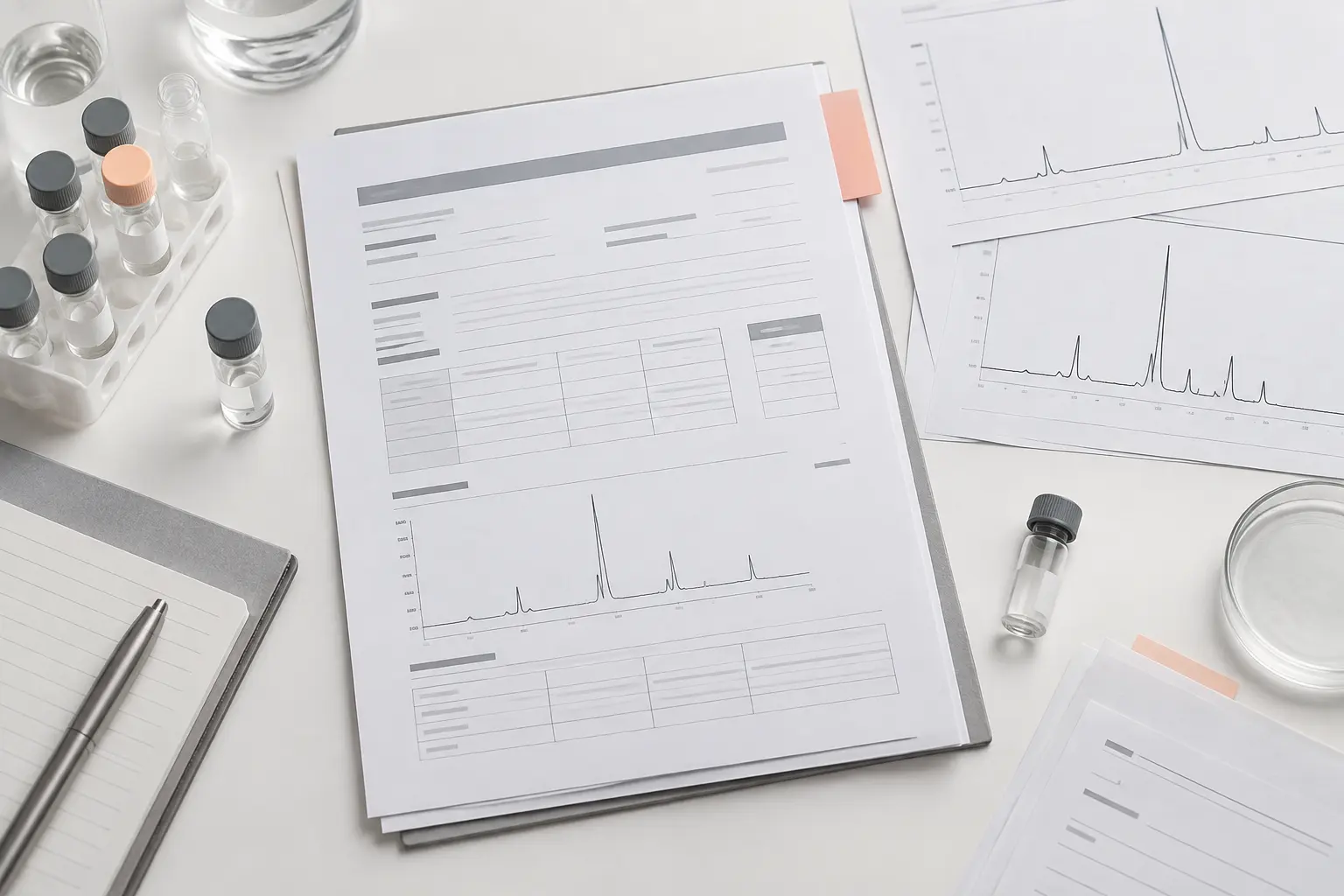
A Certificate of Analysis can help a researcher evaluate whether a material is accompanied by a coherent analytical record. It should not be treated as a decorative badge or accepted solely because it contains a purity percentage. The useful question is whether the document, methods, results, and batch identifiers fit together.
Start with document integrity
A credible review begins before interpreting any chromatogram or mass result. Confirm that the compound name, stated amount or concentration, lot number, test date, and sample identifier are present and internally consistent. The product label and the certificate should point to the same material. A polished document with no traceable batch relationship offers limited practical value.
Red flag 1: no batch or sample identifier
Without a lot number or sample identifier, there is no clear way to connect the report to the material being evaluated. Generic certificates may describe a representative sample rather than the specific batch available for research.
Red flag 2: purity presented as identity
Chromatographic purity and molecular identity answer different questions. A high area percentage can describe the relative composition detected under a defined chromatographic method, but it does not by itself establish that the main peak is the intended compound. Identity evidence should be reported separately, commonly through a mass based method or another appropriately specific procedure.
Red flag 3: a result without its method
A number has limited meaning when the analytical technique, detector, or test context is absent. Look for clear method labels such as HPLC, UPLC, LC MS, or another relevant procedure. Method details help a reviewer understand what was measured and what the result can reasonably support.
Red flag 4: missing acceptance criteria
A certificate is easier to interpret when it distinguishes the specification from the observed result. “Purity: 99.4%” is more useful when the document also states the applicable release threshold and identifies whether the batch passed that criterion.
Red flag 5: inconsistent dates or identifiers
Test dates that precede plausible production timing, conflicting lot numbers, mismatched compound names, or unexplained changes between pages should prompt further review. Minor formatting differences are not automatically disqualifying, but the analytical record should remain internally coherent.
Red flag 6: cropped or incomplete evidence
A single screenshot of a purity value removes the surrounding context needed to evaluate the result. Useful records identify the laboratory, sample, method, date, and reported outcome. Supporting chromatograms or spectra should be legible and connected to the same sample record.
Red flag 7: absolute claims from limited testing
No single test establishes every attribute of a research material. HPLC does not replace identity confirmation. Identity confirmation does not automatically quantify purity. Neither result alone establishes sterility, endotoxin status, residual solvents, fill quantity, or stability. Claims should remain within the scope of the methods reported.
A practical review sequence
- Match the compound, lot, and sample identifiers.
- Separate specifications from observed results.
- Confirm that purity and identity are reported as distinct attributes.
- Check that each result names an appropriate analytical method.
- Review dates, laboratory attribution, and supporting evidence.
- Note which quality attributes were not evaluated.
For a step by step explanation of the full document, see How to Read a Peptide Certificate of Analysis. For the broader release framework used by Not Labs, review Testing and Verification.