
Research Library Thymic Peptide Research
Thymalin is described in the literature as a thymus-derived peptide preparation rather than one universally defined single peptide. That distinction is central to experimental design, material characterization, and the limits of comparisons across studies.
For research use only. Not for human or veterinary use. This page reviews published research and documentation questions. It does not provide medical guidance, dosing, administration instructions, or claims of clinical outcome.
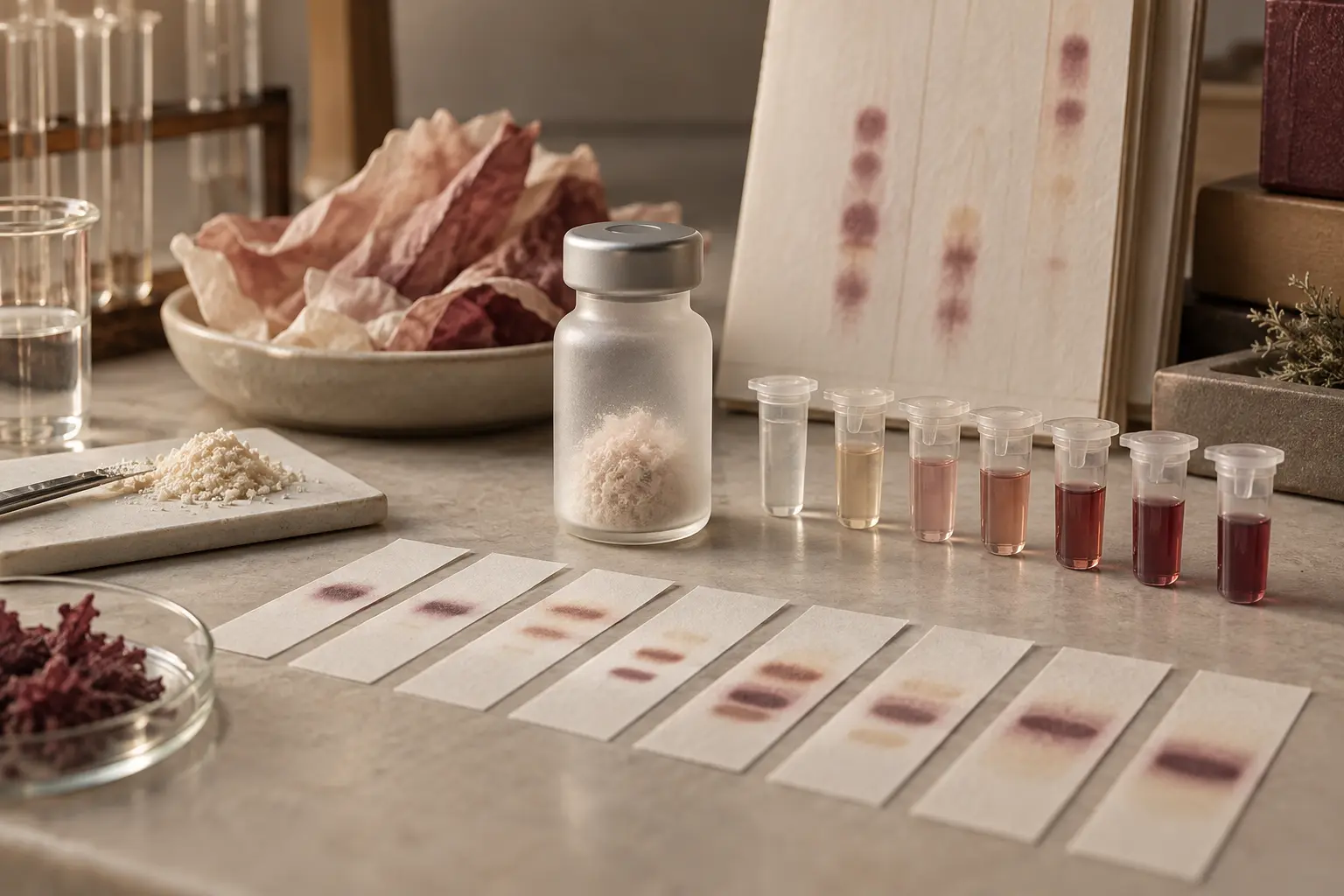
Preparation name versus defined analyte
A defined synthetic peptide can be described by one amino-acid sequence, molecular formula, and expected mass. Thymalin has historically been discussed as a low-molecular-weight peptide complex obtained from thymic tissue. Publications also discuss individual short peptides identified within or developed from thymic preparations, including Glu-Trp and other sequences. Those components should not be treated as interchangeable with the complete preparation.
Why composition matters
If a material contains multiple peptide fractions, biological activity may reflect one component, several components, or interactions that are not resolved by the experiment. A study using one manufacturing process cannot automatically establish the composition or activity of another preparation sold under the same general name.
- Source material and extraction process can affect the resulting fraction profile.
- Molecular-weight distribution does not establish the identity of every component.
- A named short peptide does not prove that the full mixture has the same behavior.
- Batch comparability requires more than a shared product name.
Research themes in the literature
Published work has examined immune-cell activity, inflammatory signaling, age-associated physiology, and gene-expression effects. Much of this literature comes from a limited group of investigators, older study designs, animal or cell models, and preparations whose composition may not match current materials. These papers support research questions, not broad conclusions about a modern batch.
Do not confuse Thymalin with thymosin alpha-1
Thymosin alpha-1 is a defined 28-amino-acid peptide. Thymalin is described as a peptide complex. Thymulin, thymopoietin, thymosin beta-4, and other thymic factors are also structurally and functionally distinct. Similar naming reflects thymic research history, not chemical equivalence.
Analytical questions for a heterogeneous preparation
- What is the stated source and manufacturing process?
- Is the material represented as one sequence or a peptide complex?
- Which components or mass ranges were measured?
- What chromatographic or mass-spectrometric profile supports batch identity?
- Can the current lot be compared with the preparation used in the cited study?
Experimental controls
Controls should match the question. A vehicle control addresses handling and matrix effects. A reference preparation can help evaluate batch comparability. If the hypothesis concerns an individual short peptide, that peptide should be tested separately rather than assuming the mixture identifies the active component. Time points, cell source, species, passage number, and baseline immune state can also change the interpretation.
Evidence boundary
Clinical or longevity claims cannot be inferred from compositional similarity, a cell-culture result, or an animal endpoint. Historical findings should be reported with the preparation, population, comparison group, and analytical limitations attached. The strongest conclusion is usually the one directly measured in the defined model.
Reporting the material
A research report should preserve the supplier description, lot number, stated source, component or fraction information, analytical methods, preparation conditions, and storage history. If composition is not fully resolved, describe the material as a peptide preparation rather than assigning every result to one sequence. Comparisons across publications should identify whether the studies used an extract, a defined short peptide, or another thymic factor. That distinction prevents a shared name from becoming false chemical equivalence.
References
- Khavinson V, et al. The use of Thymalin for immunocorrection and molecular aspects of its action. 2021.
- Khavinson V, Morozov V. Peptides of pineal gland and thymus prolong human life. Neuro Endocrinology Letters. 2003.
- Linkova N, et al. Peptides regulating proliferative activity and inflammatory signaling. 2022.