
Research Library Testing Standards
“Lab-tested” is meaningful only when the test, sample, method, result, and batch connection are clear. The phrase alone does not establish identity, purity, quantity, sterility, or fitness for a particular experiment.
Research-use notice: This guide addresses analytical documentation for laboratory materials. It does not provide medical guidance, dosing information, administration instructions, or claims of clinical outcome. Not for human or veterinary use.
Start with the claim
A testing statement should identify what was evaluated. “Purity tested,” “identity confirmed,” and “quantity verified” describe different questions. If the claim does not name the measured attribute, the reader cannot determine what evidence should support it.
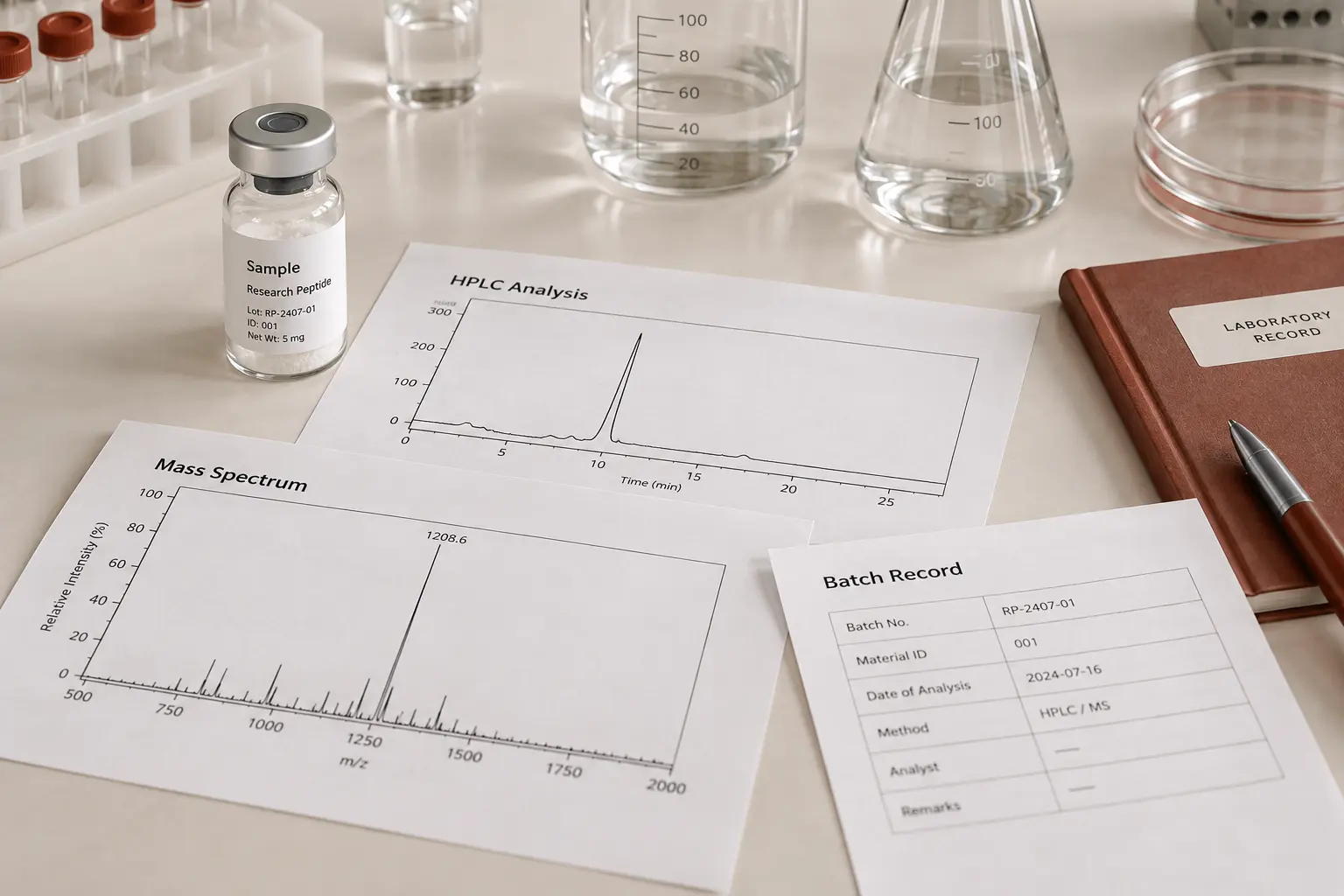
Five elements of a useful testing record
- Defined sample. The tested material should be associated with a specific lot or batch.
- Named method. The record should state the analytical technique used.
- Relevant result. The reported output should answer the stated testing question.
- Traceable documentation. Compound, lot, date, and laboratory information should align.
- Stated limitations. The document should not imply that one method establishes attributes it did not measure.
Identity and purity are separate
Identity testing asks whether the expected analyte is present. Chromatographic purity describes the relative composition detected under a defined method. A high area percentage does not independently confirm that the principal peak is the intended peptide.
That distinction is why defensible documentation should be read as a set of related records rather than a single headline percentage. See Purity vs. Identity in Peptide Testing for the full analytical comparison.
What HPLC can establish
High-performance liquid chromatography separates detected components under specified conditions. The chromatogram can support a purity assessment when the integration approach, method, and sample relationship are clear. Its interpretation remains method-dependent.
- Which peaks were detected under the stated conditions.
- The relative area associated with those peaks.
- Whether the principal detected component meets a defined chromatographic specification.
HPLC alone does not establish every quality attribute. It should not be treated as a substitute for identity confirmation, quantity determination, microbiological testing, or experimental suitability.
What mass-based identity evidence adds
Mass spectrometry can provide evidence that an analyte corresponds to an expected molecular mass or fragmentation pattern. The exact conclusion depends on the instrument, method, reference information, and reported output. A certificate should make the basis of the identity conclusion visible.
Batch linkage matters
A report cannot support a current vial if the reader cannot connect the two. Match the compound name, strength where applicable, lot number, and document date. If the certificate lacks a lot identifier or the vial and certificate disagree, the evidence chain is incomplete.
For a clearer boundary between supported findings and unsupported conclusions, review What a Peptide COA Can and Cannot Prove.
The companion guide, How to Read a Peptide Certificate of Analysis, provides a field-by-field review process.
Red flags in vague testing language
- No named analytical method.
- No lot number connecting the report to the supplied material.
- A purity percentage presented as proof of identity.
- No test date or laboratory information.
- A cropped result without the surrounding certificate context.
- Testing claims that exceed the attributes actually measured.
How Not Labs presents testing information
Not Labs links research materials to batch-level documentation and separates identity, chromatographic purity, and broader testing claims. Current product records and certificates remain the authoritative source for the lot being evaluated.
A practical review sequence
- Identify the exact testing claim.
- Confirm the method is relevant to that claim.
- Match the certificate to the current lot.
- Read identity and purity results separately.
- Record what the evidence does not establish.
References
- U.S. Food and Drug Administration. Analytical Procedures and Methods Validation for Drugs and Biologics. July 2015.
- International Council for Harmonisation. ICH Q2(R2): Validation of Analytical Procedures. Final version, November 2023.
Last reviewed: September 2026. Research-use information only. Review the current lot documentation before selecting material for an experiment.