
Research Library Experimental Design
A peptide blend places multiple research materials into one preparation or experimental workflow. That can reduce handling steps, but it also combines variables. Strong blend research begins by documenting every component independently and designing controls that can separate individual, additive, and interaction effects.
For research use only. Not for human or veterinary use. This guide addresses documentation and experimental design. It does not provide medical guidance, dosing, administration instructions, or claims that a combination is superior to its components.
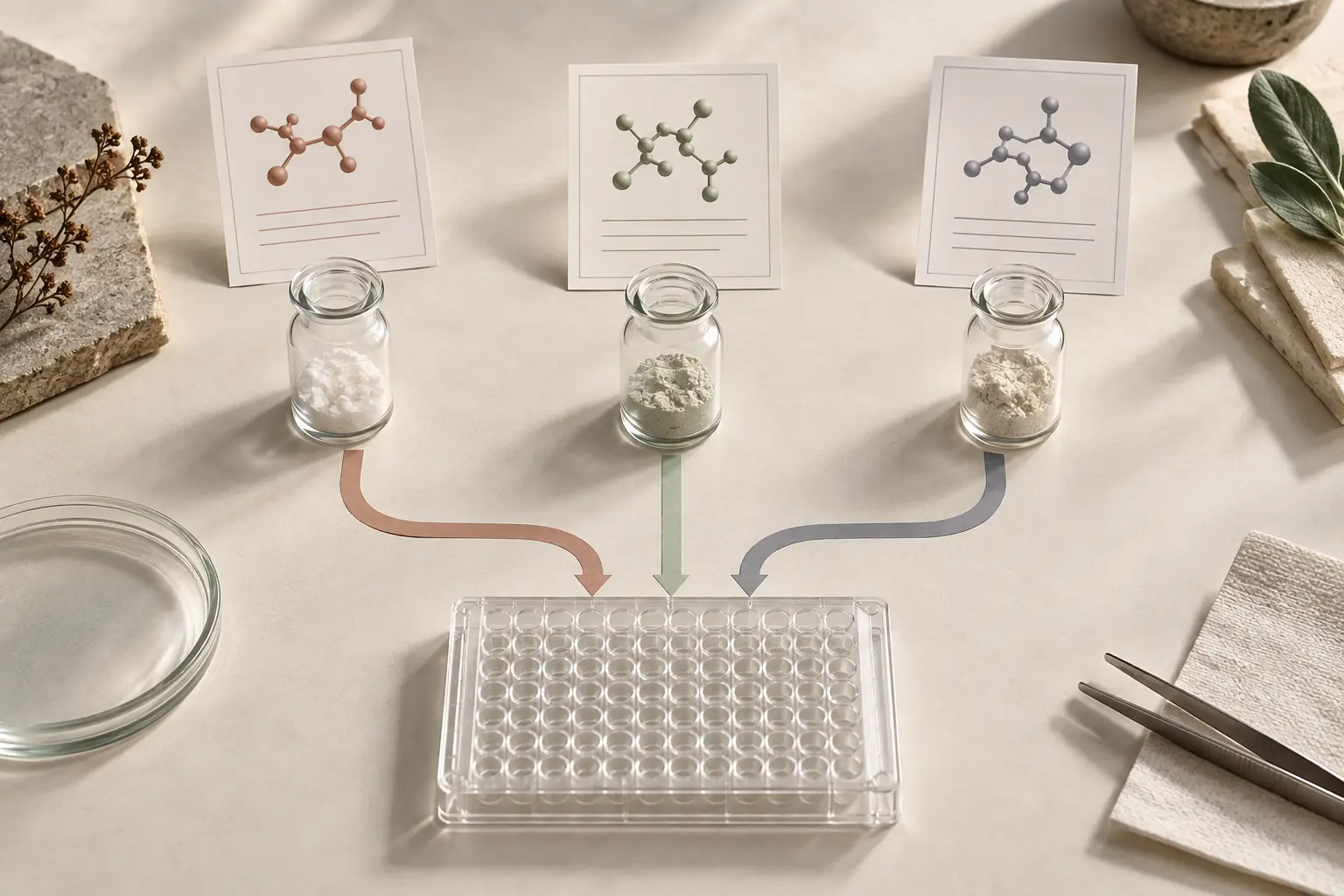
Blend, bundle, and co-testing are different
A blend contains multiple named components in one preparation. A bundle supplies separate materials that can be handled independently. Co-testing combines separate materials within a study. These formats create different documentation, stability, preparation, and control requirements. The label should make the format clear before any experimental comparison begins.
Start with component identity
A blend certificate should identify every declared component and connect the result to the current lot. A single dominant chromatographic peak cannot establish the identity or quantity of several different peptides. When components have similar masses, retention behavior, or detector responses, the method must be capable of resolving the mixture it claims to characterize.
Purity and ratio are separate questions
Chromatographic purity describes the detected profile under a stated procedure. Component ratio asks how much of each material is present relative to the others. Identity, purity, and quantity require different evidence. A high area percentage for one peak does not confirm the declared amount of every component in a blend.
The minimum useful study matrix
- Vehicle or matrix control.
- Each component tested independently under matched conditions.
- The complete blend at the defined ratio.
- A reference or positive control appropriate to the endpoint.
- Replicates sufficient to estimate variability.
Without the individual-component arms, a blend result cannot show which material contributed to the observation. Without a matched blend arm, separate-component findings cannot establish how the combined preparation behaves.
Interaction is not the same as addition
If the blend response differs from either component alone, the result may be additive, less than additive, or greater than additive. Demonstrating interaction requires a prespecified model and a suitable range of component ratios. Describing every combination as synergistic overstates what most simple comparisons can establish.
Stability can change after combination
Components may differ in solubility, charge, hydrophobicity, oxidation sensitivity, and degradation pathways. A stability result for each isolated material does not automatically apply to a combined preparation. The blend should be evaluated in its final matrix, container, concentration, and storage condition using a method capable of monitoring each relevant component and degradation product.
Documentation checklist
- List every component using a specific name and form.
- State the amount or ratio of each component.
- Connect the preparation and certificates to one lot.
- Confirm the analytical method can distinguish the declared components.
- Record preparation, matrix, container, and storage conditions.
- Include individual-component controls in the experimental design.
When separate materials are preferable
Separate vials generally provide more flexibility when a study needs independent concentration changes, staggered exposure, stability monitoring, or component-specific controls. A blend can be appropriate when the fixed composition itself is the object of study. Convenience should not replace experimental resolution.
Reporting blend results
Report the identity and lot of each component, the final ratio, preparation order, matrix, total concentration, and elapsed time before measurement. Results should show individual-component arms beside the blend rather than presenting only the combined condition. If one component changes assay sensitivity or recovery, record that interference explicitly. A clear report also distinguishes a fixed commercial preparation from a mixture assembled during the experiment, since those materials may have different stability and documentation histories.
References
- International Council for Harmonisation. ICH Q2(R2): Validation of Analytical Procedures. 2023.
- U.S. Food and Drug Administration. Analytical Procedures and Methods Validation for Drugs and Biologics.
- International Council for Harmonisation. Q6A: Specifications, Test Procedures, and Acceptance Criteria.